Published Jul 12, 2026 by Xiph
Whenever a government or a company wants to play down how much it collects about you, the phrase is almost always the same: “Don’t worry — it’s only metadata. We’re not reading your messages.” It sounds modest, even reassuring. It is neither. Metadata — the record of who you contacted, when, from where, for how long, and on what device — can paint a sharper picture of your life than the contents of any single message ever could. And in Australia, the rules governing it are weaker, in one specific and badly under-appreciated way, than the rules governing the content it is supposedly distinct from.
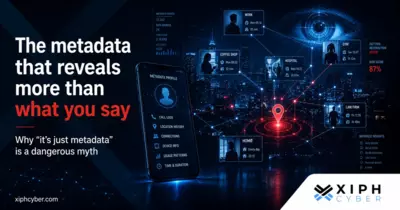
What metadata actually is
The textbook line is that metadata is “data about data.” The more useful image, and the one Australian law leans on, is the envelope versus the letter. The letter is the content — the words you typed, the things you said on the call. The envelope is everything around it: who sent it, who received it, the time it was posted, the route it took, the return address.
Under Australia’s mandatory data retention scheme, every telco and internet provider in the country is required to keep your envelope information for at least two years. That set is defined in the Telecommunications (Interception and Access) Act 1979 and covers more than most people assume: the subscriber details tied to your account, the source and destination of each communication, the date, time and duration, the type of service used, and — critically — the location of the equipment your phone connected to. It excludes the content of your messages and, in theory, your web browsing history. It does not exclude the pattern of your entire digital life.
The who/when versus the what — and why the "what" is the weaker secret
Here is the part the reassuring version skips over. The distinction between metadata and content is real, but it is not a distinction between sensitive and harmless. It is a distinction between two different kinds of sensitive — and the envelope is frequently the more revealing of the two.
Consider what the “what” of a message often hides versus what the “who and when” plainly states. The content of a single text might be “running late, see you soon” — mildly private, quickly stale. Now consider the metadata around a week of someone’s communications: a call to an oncology clinic on Monday, three calls to family that evening, a cell-tower location at a hospital on Wednesday, a call to a law firm on Friday, and a sharp drop in all other activity. No one read a word of content. Everyone reading the envelope can tell you exactly what happened.
That is the trouble with “it’s just metadata.” Patterns of association, location and timing don’t need to be decrypted or interpreted — they speak for themselves. They reveal your contacts, your movements, your relationships, your religion, your health, and your sources if you happen to be a journalist or a whistleblower. Content tells you what was said once; metadata tells you the shape of an entire life, going back years.
The warrant gap
The legal architecture makes the same mistake the marketing line does — and this is where it stops being an abstract privacy debate and starts having teeth.
To read the content of your stored communications — the body of an email, a saved message — an Australian law enforcement agency generally needs a warrant. To listen to a live call, it needs an interception warrant, signed off by an eligible judge or tribunal member. There is a gatekeeper, and a record.
To obtain your metadata, there is, in most cases, no warrant at all. An “authorised officer” inside an enforcement agency signs an internal authorisation, and the provider hands the data over. The asymmetry this produces is stark. In the five years to June 2014, Australian agencies made close to 750,000 warrantless requests for metadata — against just 1,228 warrants for the content of stored communications over the same period. The envelope, not the letter, is the workhorse of everyday surveillance, precisely because it is so much easier to reach. The single meaningful exception is the Journalist Information Warrant, bolted on after a public outcry over the prospect of agencies identifying reporters’ confidential sources by tracing who they called.
Why "it can be deleted later" isn’t the comfort it sounds like
Now the part almost nobody mentions, and the reason the casual dismissal is genuinely misleading rather than merely incomplete.
When an agency lawfully intercepts the content of your communications under a warrant, the law tells it to let go. Section 79 of the TIA Act requires the relevant chief officer to destroy those records once they are no longer likely to be needed for a permitted purpose, and the Commonwealth Ombudsman inspects agencies’ interception records — including how that material is used and destroyed — at least twice a year. There is a clock, and someone watching it.
Metadata accessed without a warrant carries no equivalent obligation. Once an agency has lawfully obtained your telecommunications data, there is no specific statutory trigger compelling it to destroy that data when it becomes irrelevant or is no longer needed — none of the destruction-and-inspection machinery that governs intercepted content applies. This isn’t a fringe interpretation. The shortcoming was prominent enough that the Australian Law Reform Commission recommended the Act be amended to require agencies to destroy irrelevant accessed metadata in a timely manner — a recommendation you only make about a duty that doesn’t yet exist. Legal scholars reviewing the scheme have put it plainly: once agencies access this metadata, they are effectively permitted to retain it indefinitely and to share it with other agencies for a broad range of purposes.
The retention period compounds the problem rather than capping it. The two-year rule is a minimum obligation on providers to keep your data available — not a ceiling, and not a destruction order. The Act expressly allows a provider to hold metadata for longer than two years, and nothing winds the agency’s own copy back once it’s been handed over. “It’s just metadata, and anyway it gets deleted” turns out to mean: it’s the most revealing record of your life, it was handed over without a judge ever seeing the request, and no rule says it ever has to be thrown away.

The Australian picture
It is tempting to treat this as a theoretical concern for activists and journalists. It isn’t. The scheme touches every Australian with a phone or an internet connection, and the safeguards have already shown cracks. A review of the regime found that at least 87 agencies beyond the intended list — bodies never meant to have routine access — had used a loophole in the Telecommunications Act 1997 to obtain metadata anyway. Once a vast store of data exists and access is cheap, the list of who reaches for it tends only to grow.
There is a reform on the horizon, but it has been there a long while. Following the Richardson review of Australia’s intelligence framework, the government committed to repealing the TIA Act, the Surveillance Devices Act 2004 and parts of the ASIO Act, replacing them with a single, technology-neutral electronic surveillance Act. Consultation has run since 2021. As things stand in 2026 the new framework has yet to land — which means the warrant gap and the destruction gap described above are still the law of the land today.
What you can do now
You can’t rewrite the retention scheme from your desk, but you can decide how large a shadow you leave inside it.
For individuals:
-
Reduce what your envelope reveals. Genuinely end-to-end encrypted messaging keeps content private and, just as importantly, keeps far more of your communications “over the top” of the providers obliged to log them.
-
Harden the device itself. An ordinary phone broadcasts identifiers and location by default. A hardened handset such as a GrapheneOS device strips out a great deal of that ambient leakage.
-
Break the link between you and the metadata. A private SIM or a Faraday pouch is worth considering if your threat model warrants it, and our guides on mobile device security and spyware prevention cover the everyday basics.
For businesses:
-
Treat the data you hold as a liability, not an asset. You can’t be compelled to disclose — or breached out of — metadata and customer records you never retained. Data minimisation is a security control, not just a compliance nicety.
-
Know your own exposure. Understand what your telcos and platforms log on your behalf, and what a lawful request to them would reveal about your operations, your staff and your clients.
-
Build in the safeguards the law leaves out. Your own retention and destruction policies, network security and system hardening all shrink the footprint an outsider — lawful or otherwise — can pull on.
A final word
“It’s just metadata” is one of the most quietly misleading phrases in the privacy debate. The envelope is not the harmless half of your communications; it is often the more revealing half, it can be obtained without a warrant, and once it has been, no rule guarantees it will ever be destroyed. Understanding that distinction is the difference between assuming you’re protected and knowing where you actually stand.
As a 100% Australian-owned cyber security company, Xiph Cyber has spent years supplying the tools and the advice to leave a smaller, safer digital footprint — hardened devices, encrypted communications, and consulting that treats your data as the liability it has quietly become. To work out where your business and your people sit, start with a risk audit or our IT consulting team, or get in touch at enquiries@xiphcyber.com.
Posted in: Security
Related reading

Claude Mythos: Anthropic's frontier AI & what it means for cyber security
May 26, 2026
Most AI announcements wash over the cyber security industry without much fuss. Mythos was different. In April 2026, Anthropic told the world it had built a model so good at finding software flaws that releasing it publicly would be irresponsible — and then handed restricted access to a coalition of the biggest names in tech to use it for defence. That is not a normal product launch. It is closer to an admission that the offence-defence balance has just shifted, and the industry has roughly tw...

When the lights could go out — nation-state hackers inside critical infrastructure
Jul 24, 2026
When we picture a serious cyber attack, we picture theft. A database of customer records spilled onto a forum, a ransomware note demanding payment, the slow public unravelling of an Optus or a Medibank. That mental model is so dominant it shapes how most Australian businesses think about risk: protect the data, and you’ve protected yourself. But some of the most dangerous intrusions on record steal nothing at all — no records, no ransom note, no money. Their entire purpose is to get inside...
What is cloud storage & is it safe?
Jun 03, 2022
Chances are you’ve used ‘the cloud’ before – when you’ve been on Instagram, YouTube, or even Gmail − (yes, they all use cloud computing). Although the majority of internet users and businesses use storage space on the internet, cloud storage and how it works is still a mystery for many. Fret not, we cover all the fast facts in this guide.s and photos in the cloud, while businesses use cloud storage for data backup, disaster recovery, archiving, and DevOps projects.